
Case Hardening vs Alloy Steel | HD Industries Guide
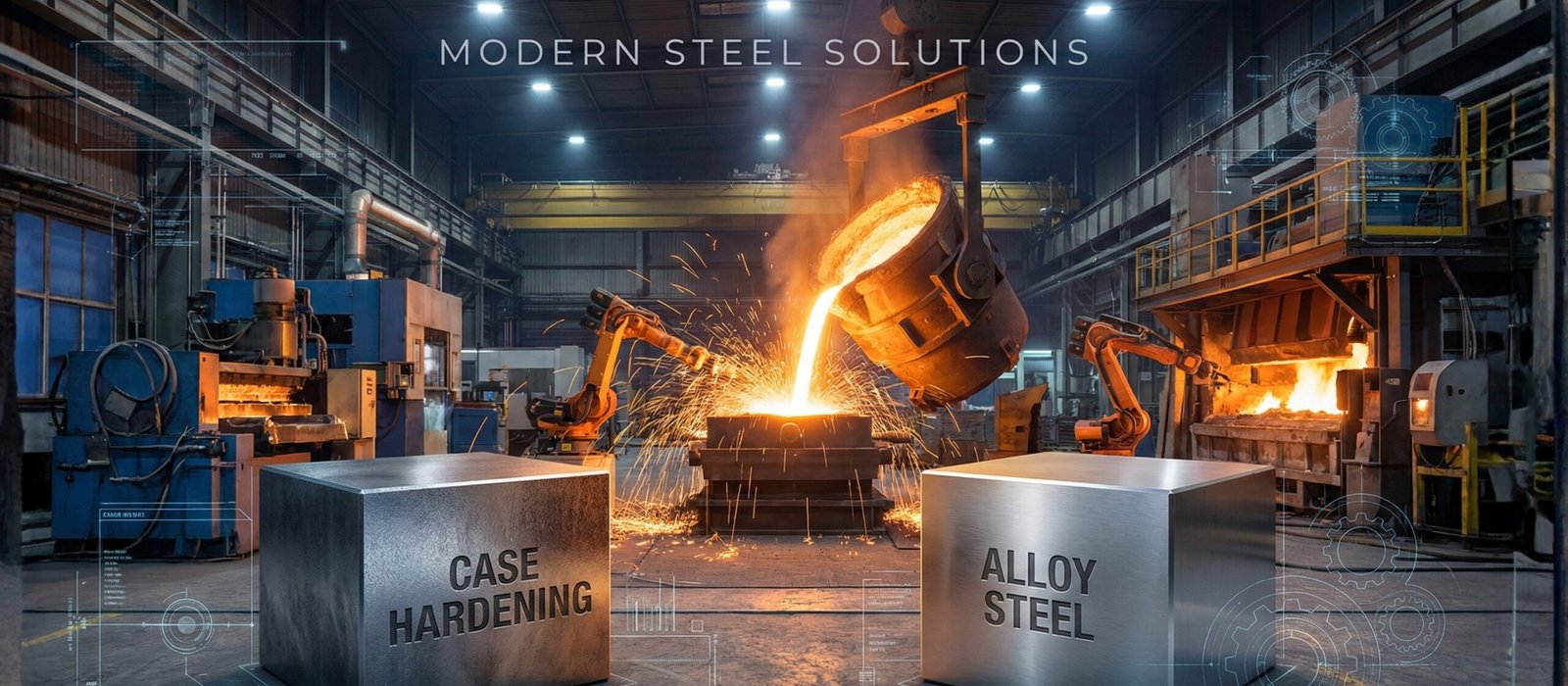
In industrial manufacturing, selecting the right steel grade directly impacts durability, efficiency, and long-term performance. Two commonly compared materials are case hardening steel and alloy steel. While both are widely used across industries, their mechanical properties and ideal applications differ significantly.
What is Case Hardening Steel?
Case hardening steel is typically a low-carbon steel that undergoes a heat treatment process to develop a hardened outer surface while maintaining a tough and ductile core. This dual property makes it highly effective in applications where surface wear resistance and internal strength are both required.
Industries commonly use case hardening steel for gears, shafts, bearings, automotive components, and heavy-duty machinery parts. The hardened outer layer resists abrasion and friction, while the softer inner core absorbs shocks and dynamic loads. This balance of hardness and toughness makes case hardening steel particularly suitable for parts exposed to repeated stress cycles.
What is Alloy Steel?
Alloy steel contains additional elements such as chromium, nickel, and molybdenum to enhance overall strength, corrosion resistance, and heat tolerance. Unlike case hardening steel, alloy steel provides uniform mechanical properties throughout the material rather than concentrating hardness only on the surface.
Add a Comment